Why Your Business Is Not Showing in ChatGPT & Google AI Results
Why Your Business Is Not Showing in ChatGPT & Google AI Results
📅 Published: May 23, 2026✍️ By: Ajay Maanju🏷️ Category: AI SEO
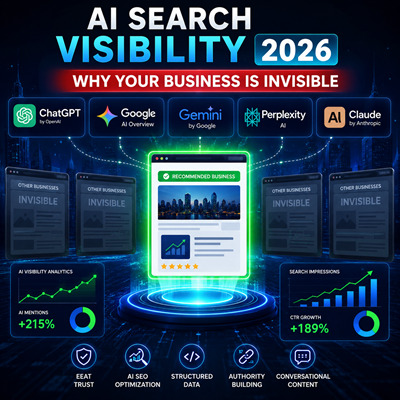
Businesses are investing heavily in SEO, websites, and digital marketing — yet many still do not appear inside ChatGPT, Google AI Overviews, Gemini, Claude, or Perplexity AI results. In 2026, traditional SEO alone is no longer enough. Modern businesses now need AI SEO and Generative Engine Optimization (GEO) strategies to improve AI visibility, citations, authority, and future search rankings. If your business is invisible in AI-generated search results, you are already losing future customers and leads.
The Biggest Shift in Search Has Already Started
Search behavior is changing rapidly. Instead of typing short keywords into Google, users now ask AI tools complete questions like:
Why Your Business Is Not Showing in AI Search Results
Most websites are still optimized only for traditional search engines. AI systems work differently.
✅ Common Reasons Businesses Stay Invisible in AI Results
Weak EEAT signals
Generic AI-generated content
No author authority
Poor website structure
Missing FAQ schema
Weak topical authority
No conversational SEO optimization
No AI-focused content strategy
Low brand mentions online
Outdated technical SEO
What Is AI SEO & GEO Optimization?
Traditional SEO focuses on ranking pages.
AI SEO focuses on helping AI systems understand, trust, and recommend your business.
This process is called Generative Engine Optimization (GEO).
GEO helps businesses improve visibility inside:
ChatGPT answers
Google AI Overviews
AI-generated recommendations
Conversational search systems
How AI Systems Decide Which Businesses to Recommend
AI Visibility Factors
Importance
EEAT signals
Very High
Structured content
High
Brand authority
High
Schema markup
High
Technical SEO
Medium
Why EEAT Matters More Than Ever in 2026
Google and AI systems prioritize:
Experience
Expertise
Authority
Trustworthiness
This is known as EEAT.
🔥 EEAT Optimization Tips:
Add expert author information
Show years of experience
Add real case studies
Display testimonials
Use original screenshots
Keep content updated regularly
Add structured FAQ sections
Real AI Visibility Case Study
A Shopify business approached us because their website traffic was stable, but they were getting almost no qualified leads from AI-powered search systems.
After auditing the website, we found major issues:
Weak EEAT signals
Generic blog structure
Missing schema markup
Poor internal linking
No AI-focused content
📈 Results After 90 Days
Organic Traffic41% increase
Lead QualityBetter & more qualified
AI VisibilityHigher appearance rate
Google AI OverviewImproved presence
User EngagementBetter overall metrics
How to Make Your Website AI Search Friendly
✅ AI Website Optimization Checklist
Add FAQ sections
Improve page speed
Use schema markup
Create topical authority clusters
Add author expertise
Use conversational headings
Improve internal linking
Publish long-form expert content
Keep content updated
Build brand mentions online
Traditional SEO vs AI SEO
Traditional SEO
AI SEO / GEO
Focus on rankings
Focus on AI visibility
Keywords
Conversational relevance
Search engines
AI answer engines
Backlinks
Authority + trust
Need Help Improving Your AI Visibility?
Building an AI-ready website requires more than traditional SEO. Businesses now need AI SEO strategies, GEO optimization, EEAT improvements, structured content, and conversational optimization to appear inside ChatGPT and Google AI results.
As a web development and Shopify expert with 12+ years of experience, Ajay Maanju helps businesses create AI-ready websites optimized for future AI search systems.
Your website may lack EEAT signals, structured content, conversational SEO optimization, schema markup, or sufficient online authority.
What is Generative Engine Optimization (GEO)?
GEO is the process of optimizing websites for AI-powered search engines like ChatGPT, Google AI Overviews, Gemini, and Perplexity AI.
Is traditional SEO enough in 2026?
No. Businesses now need both traditional SEO and AI SEO strategies to remain visible in modern AI-powered search systems.
How can I improve AI search visibility?
Improve EEAT signals, add FAQ sections, build authority mentions, optimize technical SEO, and create conversational expert-level content.
AM
Ajay Maanju — Shopify, WordPress, and AI SEO Expert
Ajay Maanju has 12+ years of experience helping businesses build scalable, AI-ready websites. He specializes in Shopify and WordPress Development, AI SEO & GEO Optimization, Technical SEO, and Website Performance. Explore services at ajaymaanju.com →
WordPress 7.0 Explained: New Features, Benefits & AI Impact for Website Owners
📅 Published: May 14, 2026✍️ By: Ajay Maanju🏷️ Category: WordPress
WordPress 7.0 is officially live on May 20, 2026 — and it is the biggest release since the Block Editor arrived in 2018. Whether you run an e-commerce store, a business website, or a content platform, this update changes how you create, collaborate, and grow online. If you are looking to hire a WordPress developer in India who understands every nuance of this landmark release, this guide gives you everything you need to know before making your next move.
Key HighlightNative AI Client, DataViews Admin, New Blocks
Next ReleaseWordPress 7.1 — August 19, 2026
What Is WordPress 7.0 and Why Does It Matter?
WordPress powers over 40% of all websites on the internet, and version 7.0 marks a true turning point. Released on May 20, 2026, this update was originally planned for April 9 during WordCamp Asia in Mumbai, but the core team postponed it to fix a critical architectural issue in the real-time collaboration engine — a sign that the team is prioritising stability over speed.
The central theme of WordPress 7.0 is "Workflows". For years, running a content team on WordPress meant juggling external tools like Google Docs, Slack, and Trello. Version 7.0 begins to bring those collaborative workflows directly into the WordPress dashboard, reducing your reliance on third-party apps and keeping your team working faster in one place.
This is also the official launch of Gutenberg Phase 3, a milestone the WordPress core team has been building toward since the Block Editor arrived in 2018.
Top New Features in WordPress 7.0
🤝
Real-Time Collaboration (RTC)
Multiple editors can now work on the same post simultaneously. Built on the Yjs CRDT engine with HTTP polling — no WebSocket required. Note: Final release ships with core RTC infrastructure; full live co-editing is planned for WordPress 7.1.
🤖
Native AI Client (WP AI Client)
A core PHP library providing a standardised interface for AI services — OpenAI, Google, Anthropic, and more. Plugins no longer need individual integrations; they share one abstraction layer.
🖥️
DataViews Admin Redesign
The WordPress admin gets its first serious visual overhaul in over a decade. DataViews replaces traditional WP List Tables with a modern, app-like interface for managing posts, pages, and custom post types.
🔌
Connectors API & Abilities API
Site owners can now configure AI providers (OpenAI, Google, Anthropic) directly from a new Connectors admin screen. The Abilities API gains a JavaScript counterpart for fine-grained capability control.
🧱
New Core Blocks
Breadcrumbs and Icons are now built into core. The Cover block supports video backgrounds. The Grid block is now fully responsive, and the Gallery block adds a native lightbox.
👁️
Pattern Spotlight & Isolated Editor
Edit synced patterns, template parts, and navigation menus in a distraction-free Isolated Editor mode — without accidentally affecting your surrounding layout.
Responsive Block Visibility
For the first time in WordPress core, editors can mark individual blocks to show or hide based on screen size — a feature that previously required a plugin or custom CSS. This is a major win for mobile-first design and eliminates a layer of complexity for developers and content editors alike.
Faster Image Handling
Image resizing and compression now happen in the browser rather than on the server. This reduces server load significantly for sites with high media throughput, such as news sites, portfolio sites, and WooCommerce stores with many product images.
WordPress 7.0 and the Rise of AI in Web Development
WordPress 7.0 does not replace your creativity with AI — it gives AI a proper home inside your CMS. The WP AI Client is a core PHP library that acts as a single, standardised bridge between WordPress and any AI provider. Instead of every plugin independently integrating with OpenAI or Anthropic, they all connect through the same abstraction layer. This means:
Switching AI providers requires just one configuration change in the admin
Plugin developers write cleaner, more interoperable code
Site owners get a single Connectors screen to manage all AI credentials
Community-built providers (OpenRouter, Ollama, Mistral) are already available
The Abilities API — first introduced on the PHP side in WordPress 6.9 — now gains a JavaScript counterpart in 7.0 through two new packages: @wordpress/abilities for state management and @wordpress/core-abilities for the WordPress integration layer. This enables frontend developers to build AI-powered block interactions that are consistent, secure, and easy to maintain.
💡 AI Visibility Tip for Website Owners: Google's Search Generative Experience (SGE) and AI tools like ChatGPT increasingly pull structured answers from well-organised websites. WordPress 7.0's new schema-friendly block architecture, combined with proper FAQ blocks and structured content, gives your site a direct competitive advantage in AI-generated search results.
If you run a business website built on WordPress, here is what WordPress 7.0 concretely means for you:
Faster content operations: The DataViews admin redesign makes managing large volumes of posts, products, and pages significantly faster. Teams no longer waste time navigating a dated interface to find and edit content.
Lower plugin dependency: Features like block visibility, gallery lightbox, breadcrumbs, and the AI Client were previously handled by plugins. With them now in core, your site becomes leaner, faster, and more secure by reducing the plugin surface area.
Better team collaboration: Even before real-time co-editing is fully active, the improved Notes system, synced pattern editing, and isolated editor mode make it much easier for designers, developers, and content writers to work together without stepping on each other's changes.
Future-proof AI readiness: Sites built correctly on WordPress 7.0 are positioned to integrate AI-powered features — from smart content suggestions to automated SEO recommendations — as the ecosystem matures through 7.1 and 7.2.
Is Your Site Ready to Upgrade? The Pre-Upgrade Checklist
✅ WordPress 7.0 Upgrade Checklist
Verify your PHP version — must be 7.4 minimum; upgrade to PHP 8.3 for best performance
Back up your entire site (files + database) before applying the update
Check your theme — Divi, Elementor, Astra, GeneratePress must have confirmed 7.0-compatible updates
Audit critical plugins — Yoast SEO, WooCommerce, WPML, Gravity Forms should be updated first
Test on a staging environment before updating your live site
If using add_meta_box(), migrate to register_post_meta() to stay compatible with the collaboration layer
Wait for WordPress 7.0.1 (expected within 2 weeks of launch) for additional stability
Test the new DataViews interface with your team before rolling out to editors
Need Help Upgrading to WordPress 7.0?
Upgrading a live business website requires careful planning, staging environments, and expert plugin auditing. As a specialist WordPress developer in India, Ajay Maanju handles the entire migration — safely, efficiently, and with zero downtime for your visitors.
How WordPress 7.0 Improves Your Website's AI Visibility
AI visibility — the ability of your website to appear in AI-generated answers from tools like Google SGE, ChatGPT, Perplexity, and Claude — is rapidly becoming as important as traditional SEO. WordPress 7.0 contributes to this in several direct ways:
Schema-ready block structure: The new Breadcrumbs block generates proper schema markup automatically, improving how AI engines and search crawlers understand your site's content hierarchy.
Cleaner HTML output: The DataViews admin and improved block editor produce leaner, more semantic HTML — the kind that large language models (LLMs) parse more accurately when generating summaries or direct answers.
FAQ and structured content patterns: WordPress 7.0's pattern library encourages structured content creation. AI answer engines reward structured, question-and-answer formatted content — making the FAQ block one of the highest-value content patterns you can use.
Faster Core Web Vitals: Browser-side image compression and the responsive Grid block reduce layout shift and improve loading speed — both of which are signals that affect how AI search surfaces treat your pages.
To maximise your website's AI visibility in 2026, combine WordPress 7.0's structural improvements with a consistent content strategy. If you need expert guidance on this, hire a WordPress developer in India who understands both technical SEO and AI optimisation.
Frequently Asked Questions About WordPress 7.0
What is WordPress 7.0?
WordPress 7.0 is the biggest major release of the world's most popular CMS since the Block Editor launched in 2018. Released on May 20, 2026, it introduces the WP AI Client, DataViews admin redesign, new core blocks (Breadcrumbs, Icons), real-time collaboration infrastructure, responsive block visibility, and the Connectors API for managing AI provider credentials.
When was WordPress 7.0 released?
WordPress 7.0 officially released on May 20, 2026. It was originally planned for April 9, 2026, but the release was delayed to resolve a critical database architecture issue in the real-time collaboration feature.
What PHP version is required for WordPress 7.0?
WordPress 7.0 requires a minimum PHP version of 7.4. Support for PHP 7.2 and 7.3 has been officially dropped. The WordPress core team strongly recommends PHP 8.3 or higher for optimal performance, security, and DataViews interface speed.
Does WordPress 7.0 have built-in AI?
Yes. WordPress 7.0 ships with the WP AI Client — a standardised core PHP library that allows plugins and themes to integrate AI services (OpenAI, Google Gemini, Anthropic Claude, Ollama, Mistral, and more) through a single, consistent interface. The Connectors API lets site owners manage their AI provider credentials directly in the WordPress admin.
Should I hire a WordPress developer in India to upgrade to WordPress 7.0?
For business websites, WooCommerce stores, or any site with custom plugins and premium themes, hiring an expert WordPress developer in India is highly recommended. A professional like Ajay Maanju will audit your current stack, test on a staging server, handle PHP version upgrades, ensure plugin compatibility, and migrate your site safely — protecting both your SEO rankings and your users' experience.
What is coming in WordPress 7.1?
WordPress 7.1 is tentatively scheduled for August 19, 2026. It is expected to bring further real-time collaboration improvements, enhanced media workflows, and more granular user permission controls. WordPress 7.2 is anticipated around December 2026 with continued progress on multilingual capabilities.
AM
Ajay Maanju — WordPress Developer & SEO Expert, India
Ajay Maanju helps businesses grow online through high-performance WordPress websites, SEO strategies, and mobile application development. Based in India, Ajay has worked with clients across industries to build fast, secure, and scalable digital experiences. Explore services at ajaymaanju.com →
Ready to Build or Upgrade Your WordPress Site?
From fresh WordPress 7.0 builds to complex migrations and AI-powered feature integrations — get expert WordPress development services from India at competitive rates.
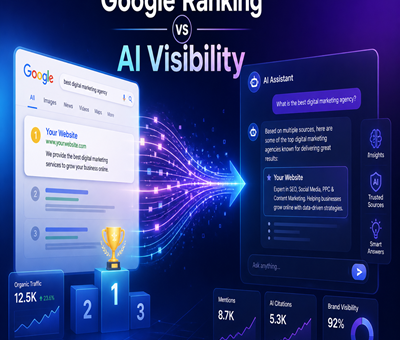
For years, businesses have chased one goal: ranking #1 on Google. It was the ultimate measure of online success.
But things have changed—fast.
With the rise of AI-powered search engines like ChatGPT, Google SGE, and others, users are no longer just clicking links. They’re getting direct answers. And often, those answers don’t come from the #1 ranked page.
So the real question is: If users aren’t clicking, does ranking still matter?
Let’s break it down.
The Shift from Search Engine to Answer Engine
Traditional search works like this:
User searches a keyword
Google shows 10 blue links
User clicks the top result
But AI search works differently:
User asks a question
AI generates a direct answer
Sources are summarized, not clicked
This means:
Visibility is shifting from rankings to mentions.
Why #1 Ranking Alone Is Losing Power
Even if your website ranks #1, you might still lose traffic because:
AI tools summarize multiple sources (not just yours)
Users don’t always click links anymore
Featured snippets and AI overviews reduce CTR
Voice and conversational queries dominate
So yes, ranking still matters—but it’s no longer enough.
What Actually Matters Now: AI Visibility
Instead of only focusing on SEO rankings, you need to focus on:
1. AI Citations
Your content should be structured so AI tools can easily reference it.
2. Brand Mentions
Even if users don’t click, your brand should appear in AI-generated answers.
3. Topical Authority
AI prefers websites that consistently cover a topic in depth.
4. Structured & Clear Content
AI loves:
FAQs
Lists
Clear headings
Direct answers
How AI Tools Choose Content
AI platforms like ChatGPT, Gemini, and Perplexity typically prioritize:
High-quality, well-structured content
Pages with strong authority signals
Frequently cited sources
Content that answers questions clearly
They don’t just pick the #1 Google result—they pick the best answer.
How to Optimize for AI Search (Not Just Google)
Here’s what you should start doing right now:
✅ Create Answer-Focused Content
Write like you’re directly answering a user question.
✅ Add FAQ Sections
This increases chances of being picked by AI.
✅ Use Natural Language
Think conversational, not keyword-stuffed.
✅ Build Topical Clusters
Instead of one page, create multiple related articles.
✅ Improve Entity & Brand Signals
Mention your brand consistently across platforms.
✅ Get Cited on Other Websites
AI trusts content that is referenced elsewhere.
Traditional SEO vs AI SEO
Factor
Traditional SEO
AI Search Optimization
Goal
Rank #1
Get cited in AI answers
Focus
Keywords
Context & intent
CTR
High importance
Lower importance
Content
Keyword optimized
Answer optimized
Authority
Backlinks
Mentions + trust
The Future: Search Without Clicking
We are entering a “zero-click” world where:
Users trust AI summaries
Traffic decreases but visibility increases
Branding becomes more important than ranking
Winning in this era means being present in answers, not just search results.
FAQ Section (For AI & SEO Boost)
Q1: Is ranking #1 on Google still important?
Yes, but it’s no longer the only goal. AI search often bypasses traditional rankings.
Q2: What is AI visibility?
AI visibility means your content is cited, referenced, or used in AI-generated answers.
Q3: How can I appear in ChatGPT or AI answers?
Create structured, high-quality content with clear answers, FAQs, and authority signals.
Q4: Does SEO still matter in 2026?
Yes, but it has evolved. SEO now includes AI optimization, not just rankings.
Q5: What type of content works best for AI search?
Informational blogs
How-to guides
FAQs
Comparison articles
Conclusion
Ranking #1 on Google is no longer the finish line—it’s just one part of the race.
In the age of AI search, success means:
✔ Being cited ✔ Being mentioned ✔ Being trusted
The brands that adapt early will dominate the next generation of search.