
How to Build an AI Search Friendly Website
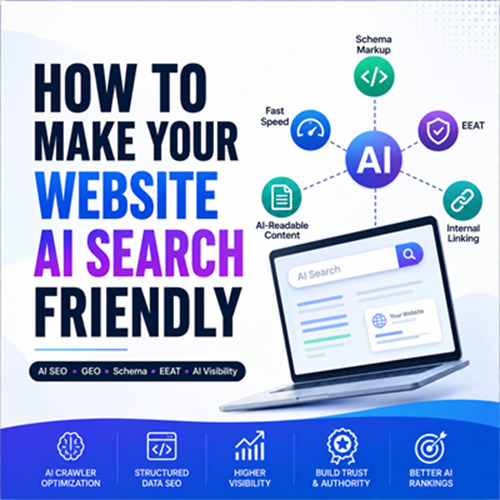
In 2026, ranking on Google's first page is no longer the finish line. ChatGPT, Gemini, Perplexity AI, and Google AI Overviews now decide which businesses get recommended directly inside a conversation. If your website isn't built to be understood by these systems, you simply won't be cited — no matter how good your content is. Building an AI search friendly website means combining structured data SEO, technical performance, and strong EEAT signals so AI crawlers can read, trust, and recommend your business. This guide shows you exactly how to make your AI search friendly website checklist a reality.
This guide breaks down exactly how to make your site AI-ready, step by step.
Why "AI-Ready SEO" Is Different From Traditional SEO
Traditional SEO is built around keywords and backlinks. AI search engines work differently — they extract facts, summarize entities, and verify trust before quoting a source. That's why an AI-ready SEO strategy has to focus on clarity, structure, and verifiable authority rather than keyword density alone.
We covered the core reasons businesses disappear from AI results in our earlier guide, Why Your Business Is Not Showing in ChatGPT & Google AI Results — this post picks up where that one left off and shows you exactly what to fix.
1. Schema Markup: Speak the Language AI Understands
AI crawlers don't "read" a page the way humans do — they parse structured data to understand what a page is about. Without schema optimization, even great content can be misread or ignored.
✅ Schema types every AI-friendly website needs:
- Organization schema (business name, logo, contact details)
- Article / BlogPosting schema
- FAQ schema
- Breadcrumb schema
- Author schema with credentials
- Product or Service schema (for businesses selling online)
Adding clean, validated schema is one of the fastest ways to turn raw content into machine-readable facts that AI systems can confidently cite.
2. Fast Website Speed: AI Crawlers Don't Wait
Page speed has always mattered for SEO — but it matters even more for AI crawler optimization. AI bots crawl thousands of pages quickly; slow-loading, render-heavy sites often get skipped or only partially indexed.
- Compress and lazy-load images
- Use a lightweight, caching-enabled hosting setup
- Minify CSS/JS and remove unused scripts
- Serve content with a CDN
- Keep Core Web Vitals (LCP, CLS, INP) in the "good" range
A fast site doesn't just rank better — it gets fully crawled, which is the first requirement for AI visibility.
3. EEAT: The Trust Layer AI Search Relies On
Google and AI models both lean heavily on Experience, Expertise, Authority, and Trustworthiness (EEAT) to decide which sources are safe to recommend.
EEAT signals to strengthen:
- Real author bios with credentials and experience
- Original case studies and data, not generic AI-written content
- Genuine testimonials and reviews
- Transparent contact and business information
- Regularly updated, fact-checked content
Weak EEAT is one of the most common reasons businesses stay invisible in AI answers — it's worth auditing this before anything else.
4. AI-Readable Content: Write for Extraction, Not Just Ranking
AI systems extract short, direct answers from content — so your structure matters as much as your writing. AI-readable content is scannable, conversational, and broken into clear, answerable chunks.
How to structure AI-readable content:
- Open sections with a direct, question-style heading
- Answer the question in the first 1–2 sentences
- Use bullet points and short paragraphs over long blocks of text
- Add a dedicated FAQ section using natural, spoken-language questions
- Avoid fluff — AI models reward clarity over word count
5. Internal Linking: Build Topical Authority AI Can Follow
Strong internal linking helps AI crawlers understand how your content connects, which topics you're authoritative on, and which pages carry the most weight. Every related article should link to and from your core AI SEO content — for example, this guide builds directly on Why Your Business Is Not Showing in ChatGPT & Google AI Results, creating a topic cluster AI systems can map and trust.
Internal linking best practices:
- Link between related, in-depth articles (not just the homepage)
- Use descriptive, keyword-relevant anchor text
- Group content into topic clusters (e.g., "AI SEO," "Technical SEO," "EEAT")
- Keep important pages within 2–3 clicks of the homepage
AI Website Optimization Checklist
| AI Visibility Factor | What to Fix |
|---|---|
| Schema markup | Add Organization, Article, FAQ & Author schema |
| Website speed | Optimize images, hosting & Core Web Vitals |
| EEAT signals | Add real author bios, case studies, reviews |
| AI-readable content | Short answers, FAQs, conversational headings |
| Internal linking | Connect related articles into topic clusters |
| Structured data SEO | Validate markup with Google's Rich Results Test |
Traditional SEO vs AI-Ready SEO
| Traditional SEO | AI-Ready SEO / GEO |
|---|---|
| Focus on rankings | Focus on AI visibility & citations |
| Keyword density | Conversational, extractable answers |
| Backlinks | Authority, EEAT & verified facts |
| Meta tags only | Full schema markup + structured data |
Need an AI Search Friendly Website?
Making a website AI-ready takes more than installing an SEO plugin — it requires schema optimization, performance tuning, EEAT-focused content, and a deliberate internal linking strategy.
As a web development and SEO expert with 12+ years of experience, Ajay Maanju helps businesses build AI-ready websites that show up inside ChatGPT, Google AI Overviews, and Gemini results.
Contact Now Visit AjayMaanju.comFrequently Asked Questions
What does it mean to make a website AI search friendly?
It means structuring your site with schema markup, fast performance, strong EEAT signals, and clear, extractable content so AI search engines like ChatGPT and Google AI Overviews can read, trust, and recommend it.
Does schema markup really help with AI search visibility?
Yes. Schema gives AI crawlers structured, unambiguous facts about your business, content, and authorship — making it far easier for them to cite your site accurately.
How important is website speed for AI crawler optimization?
Very important. Slow or render-heavy pages risk incomplete crawling, which means AI systems may never fully index your content in the first place.
Is EEAT a ranking factor for AI search engines too?
Yes. EEAT (Experience, Expertise, Authority, Trustworthiness) is one of the strongest signals both Google and AI models use to decide which sources are safe to recommend.