
Zero-Click Search Is Here: How to Get Traffic When 58% of Searches Never Get a Click
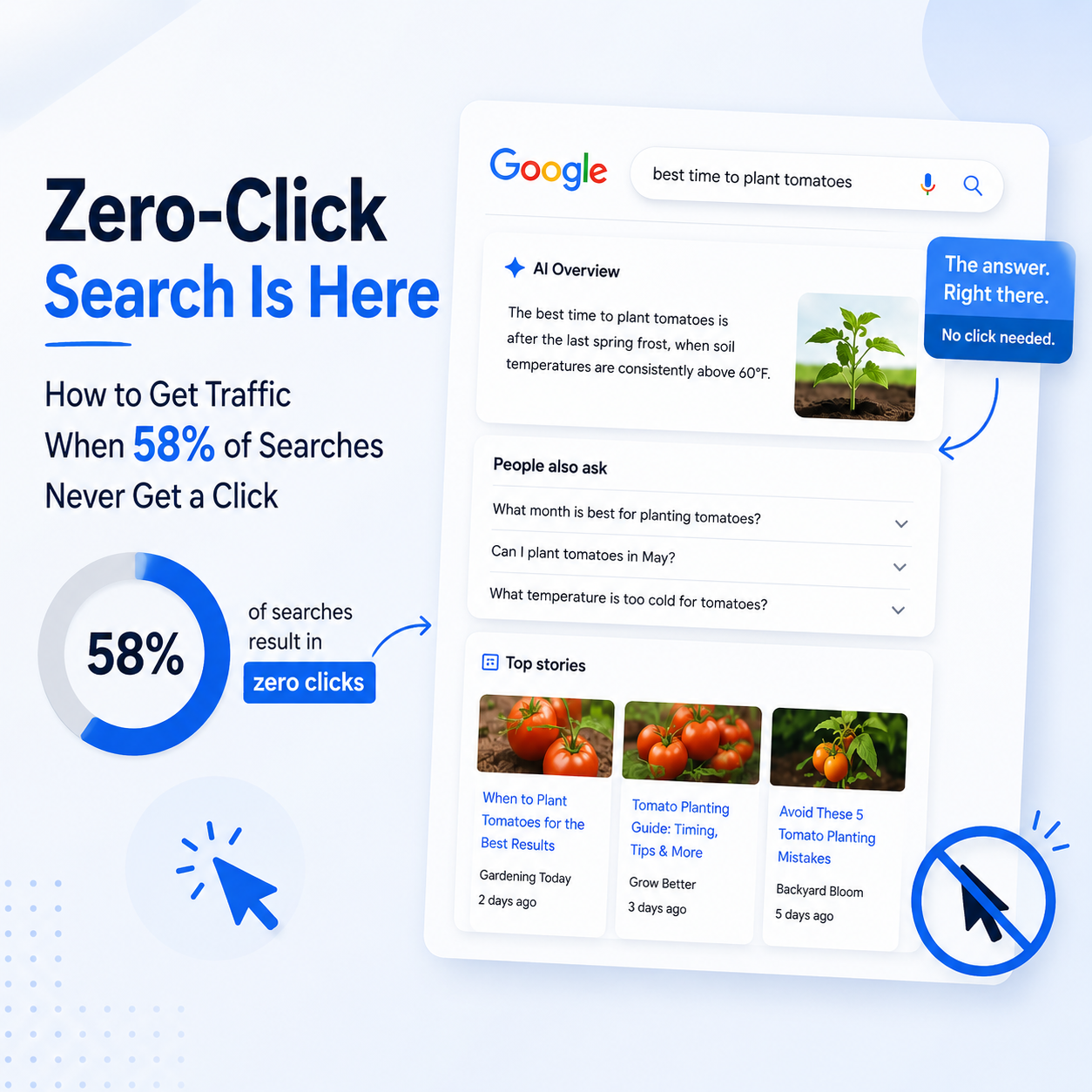
Type a question into Google today and there's a good chance you'll never click a single link. You'll read the answer right there on the results page and move on. That's a zero-click search, and it's no longer a rare outcome — it's the default. In the US alone, 58.5% of Google searches now end without a click to any website, and when an AI Overview shows up, that number jumps to roughly 83% (Arfadia, 2026). More recent tracking from SparkToro puts the broader zero-click rate even higher, at around 68% in early 2026 (Search Engine Land, 2026).
If you've noticed your rankings holding steady while your traffic quietly drops, this is why. It's not a penalty, and it's not something broken in your SEO. It's a structural shift in how search works — and it rewards a completely different set of tactics than the ones that got you ranked in the first place. This guide breaks down exactly what's happening, why it's accelerating, and what to actually do about it.
What Is a Zero-Click Search, Exactly?
A zero-click search is any query where the person gets their answer directly on the results page and never visits a website. Ask Google "how many teaspoons in a tablespoon" and it tells you instantly. Ask "current USD to INR rate" and a live converter appears. Ask a more complex question like "best CRM for a small team" and increasingly, an AI Overview summarizes the answer using content pulled from several sites — often without sending you to any of them.
This isn't new. Featured snippets and knowledge panels have been chipping away at click-through rates since around 2018. What's changed is the scale. Zero-click behavior has climbed steadily from roughly 50% of searches in 2019 to nearly 65% today, and AI Overviews have sharply accelerated that curve over the past 18 months (Digital Applied, 2026).
The Numbers: How Big Is the Zero-Click Shift in 2026
Here's the current data landscape, pulled from the most cited industry sources this year:
| Metric | Figure | Source |
|---|---|---|
| US searches ending with zero clicks | 58.5% – 68% | SparkToro / Arfadia, 2026 |
| Zero-click rate when AI Overview appears | ~83% (93% in AI Mode) | Bain & Company / Semrush, 2025–26 |
| Mobile zero-click rate vs desktop | 77% vs 46.5% | Strategyc, 2026 |
| Informational queries that go zero-click | 74% | Strategyc, 2026 |
| Transactional queries that go zero-click | Only 31% | Strategyc, 2026 |
| Organic CTR drop when AI Overview appears | Roughly 58–61% | Ahrefs / Amsive, 2025–26 |
| Consumers relying on AI-generated answers for 40%+ of searches | 80% | Bain & Company, 2025 |
Two of these numbers matter more than the rest. First, the mobile vs desktop gap: if most of your audience searches on their phone, you're already living in the higher end of that zero-click range. Second, the informational vs transactional split: "how to" and "what is" content gets swallowed by AI Overviews far more often than "buy," "hire," or "near me" searches, which still overwhelmingly send clicks (Strategyc, 2026).
Why AI Overviews Are Speeding This Up
Featured snippets used to answer simple, single-fact questions. AI Overviews go further — they synthesize an answer from multiple sources into a few paragraphs, which satisfies far more of the questions people used to click through for. Google isn't the only one doing this. ChatGPT, Perplexity, and Gemini all resolve queries the same way, and AI assistants are expected to handle roughly a quarter of all global search-style queries this year (Squarespace SEO Trends, 2026).
The uncomfortable part: this isn't a temporary dip that reverses once the AI Overview novelty wears off. Bain & Company's research shows 80% of consumers now rely on AI-generated answers for at least 40% of their searches — this is becoming the normal way people search, not an edge case (Omnibound, 2026).
Zero-Click SEO vs Traditional SEO
| Traditional SEO | Zero-Click SEO (2026) |
|---|---|
| Success = ranking #1 for a keyword | Success = being the source an AI answer cites |
| Metric: clicks and sessions | Metric: impressions, brand mentions, AI citations |
| Content built to rank a page | Content built to be quoted or extracted |
| Wins on backlinks and keyword density | Wins on structured data, clarity, and topical authority |
| One-time optimization, then wait | Continuous freshness — AI favors recently updated sources |
The good news buried in this shift: even when users don't click, repeated exposure to your brand inside AI answers and SERP features still builds trust and drives conversions later in the buying journey (Semrush, 2026). You're not invisible. You're just being measured on a different scoreboard.
6 Ways to Actually Get Traffic in the Zero-Click Era
1. Write to Be Extracted, Not Just Ranked
AI Overviews and featured snippets pull from content that's already structured for extraction: a clear question as a heading, a direct 1–2 sentence answer immediately underneath, then supporting detail. Rambling intros and buried answers get skipped over — clarity gets cited (eDesign Interactive, 2026).
2. Go After Transactional, Not Just Informational Keywords
Since transactional searches ("hire," "buy," "get a quote near me") stay zero-click only 31% of the time versus 74% for informational queries, weighting your content strategy toward commercial-intent topics protects your actual traffic and leads (Strategyc, 2026).
3. Build Brand Search Demand
Branded keywords behave differently — Amsive's data found search terms containing a brand name actually gained click-through even when an AI Overview appeared, up nearly 19% (Clickforest, 2026). The more people search your business name directly, the less the zero-click trend affects you. Consistent content, PR mentions, and social proof all feed this.
4. Add Schema Markup Everywhere It Fits
Structured data (FAQ schema, Article schema, Product schema, LocalBusiness schema) is what makes your content machine-readable enough to be pulled into snippets, knowledge panels, and AI citations in the first place. Sites using structured data consistently see stronger visibility in SERP features (Digital Applied, 2026).
5. Own Your Google Business Profile and Local Signals
For service businesses, local zero-click results (map packs, knowledge panels) are where most visibility now happens. Keeping your profile updated with fresh photos, accurate hours, and active review responses directly increases how often you're the one Google recommends without a click (CS Web Solutions, 2026).
6. Track Different Numbers
If you're still judging content success purely by sessions and clicks, you're measuring the wrong thing. Impressions, SERP feature appearances, branded search volume, and AI citation frequency are now the leading indicators — and only about 1 in 5 marketers currently track AI visibility at all, which is a real competitive gap to fill (Averi.ai, 2026).
Zero-Click Content Checklist
| Element | Why It Matters |
|---|---|
| Question-based H2/H3 headings | Matches how AI Overviews and voice search parse content |
| Direct answer in the first 1–2 sentences | Gives AI/snippet engines something clean to extract |
| FAQ schema on every blog post | Increases eligibility for rich results and AI citations |
| Author bio with real credentials | Builds the E-E-A-T signal AI systems weigh heavily |
| Updated "last modified" dates | AI systems favor recently refreshed sources |
| Branded, commercial-intent pages | Keeps click-through where it still reliably happens |
How This Connects to AI Search Visibility (GEO)
Optimizing for zero-click search and optimizing for AI search visibility are really the same job wearing two names. Getting cited inside an AI Overview or a ChatGPT answer requires the same structured, authoritative, freshly-updated content that ranks in traditional search — it's just measured by citations instead of clicks. We cover the technical side of this in detail in How to Make Your Website AI Search Friendly, including schema setup and content structure. And if you're a small business trying to compete with bigger names on top of this shift, How Small Businesses Can Use AI Automation to Compete With Big Brands shows how automation and AI visibility work together.
Ready to Rank for Clicks and Citations?
Zero-click search isn't going away — it's the new baseline. The businesses that win from here are the ones whose sites are fast, structured, and built to be the source AI systems trust enough to cite.
As a web development and SEO expert with 12+ years of experience, Ajay Maanju builds high-performance, AI-ready WordPress sites designed for both traditional rankings and AI search visibility.
Contact Now Visit AjayMaanju.comFrequently Asked Questions
What is a zero-click search?
A zero-click search is a Google query where the user gets their answer directly on the results page — through a featured snippet, knowledge panel, or AI Overview — without clicking through to any website.
What percentage of searches are zero-click in 2026?
Roughly 58% to 68% of US Google searches now end without a click, and that rises to about 83% when an AI Overview appears on the results page (Arfadia, 2026; Search Engine Land, 2026).
Does zero-click search mean SEO doesn't work anymore?
No. It means the goal is shifting from clicks to visibility. Businesses that appear inside AI answers and SERP features still build brand trust and see stronger conversions once a click does happen — brands cited in AI Overviews convert visitors at meaningfully higher rates than average organic traffic.
How do I optimize my website for zero-click search?
Structure content around direct question-and-answer formats, add FAQ and Article schema, strengthen your author and business E-E-A-T signals, and prioritize commercial-intent keywords that still reliably drive clicks.
Which types of searches are least affected by zero-click results?
Transactional, commercial-intent searches like "hire a developer" or "buy [product] near me" stay zero-click only about 31% of the time, compared to 74% for general informational queries — meaning bottom-funnel content is your safest traffic source right now.