
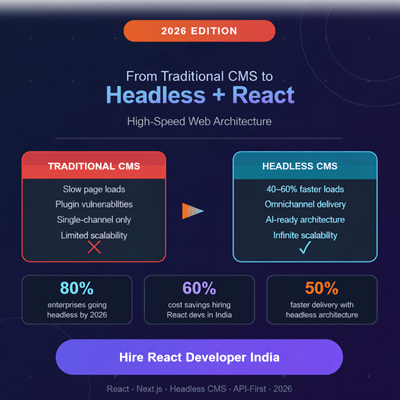
The web has always been a moving target — but in 2026, it’s moving faster than ever. Brands that built their digital presence on traditional CMS platforms like WordPress or Drupal are waking up to an uncomfortable truth: the very foundations they relied on for years are now holding them back. Loading times, scalability limits, plugin vulnerabilities, and inability to serve content across multiple channels simultaneously are no longer acceptable trade-offs.
Enter headless architecture powered by React — the combination that’s rapidly becoming the gold standard for brands that are serious about performance, scalability, and future-readiness. And for teams looking to build these next-generation experiences without blowing their budgets, the decision to hire React developers in India is proving to be the smartest business move of the decade.
In this comprehensive guide, we’ll break down the shift from traditional CMS to headless web apps, what’s driving it, why React is the frontend of choice, and how hiring skilled Indian React developers gives you a serious competitive edge.
The Problem with Traditional CMS in 2026
For years, platforms like WordPress, Joomla, and Drupal defined how the web worked. They were revolutionary for their time — offering non-technical users the ability to publish content quickly through a unified system. But the digital landscape has changed dramatically.
Traditional CMS platforms tie the frontend (what users see) tightly to the backend (where content is stored and managed). This “coupled” or “monolithic” architecture was fine in the era of single-device, desktop-first websites. Today, it’s a liability.
Here’s what the data says:
- WordPress still powers 43% of all websites globally, but its dominance is increasingly accompanied by performance trade-offs and security headaches.
- In 2025, over 11,000 vulnerabilities were reported in WordPress, with around 90% of them originating from plugins and themes.
- 49% of WordPress users report it takes over an hour to publish content, and 14% face delays of a full day or more — a critical barrier in fast-moving, multichannel environments.
- Traditional CMS platforms struggle to deliver content seamlessly to mobile apps, IoT devices, voice interfaces, and emerging digital touchpoints.
The old model — a single template rendering content for a single channel — simply can’t keep up. Brands are realizing this, and they’re acting on it.
What Is Headless Architecture, and Why Does It Matter?
The term “headless” simply means removing the “head” — the frontend — from the CMS. Instead of the CMS controlling both how content is stored and how it’s displayed, the backend becomes a pure content repository that delivers data via APIs. The frontend is then built independently, usually using a modern JavaScript framework like React.
Think of it like a central kitchen supplying multiple restaurants, food trucks, and delivery services simultaneously. The kitchen (your CMS) focuses on preparing great content. The delivery mechanism (React, Next.js, etc.) decides how that content reaches each customer — whether through a website, a mobile app, a smartwatch, or even an AI interface.
The results are measurable and significant:
- Headless architecture delivers 40–60% lower latency and up to 50% faster load times compared to traditional CMS platforms, thanks to CDN caching and static site generation.
- 79% of headless adopters report improved scalability compared to their monolithic predecessors.
- 80% of headless adopters feel their organization is ahead of competitors in delivering new digital experiences.
- One major e-commerce platform that migrated to AI-powered headless CMS in 2025 achieved a 26% increase in online orders and a 50% improvement in website performance.
- Development teams report 30–50% faster feature delivery as coordination overhead disappears.
The market is responding accordingly. The global headless CMS market is expanding from $973.8 million in 2025 to a projected $7.11 billion by 2035, reflecting a compound annual growth rate of 22.6%. More than 80% of large enterprises plan to adopt headless or composable CMS architectures by 2026 as part of their broader digital transformation strategies.
This isn’t hype — it’s a fundamental architectural shift driven by real business outcomes.
Why React Is the Frontend of Choice for Headless Architecture
When brands go headless, they need a powerful, flexible, and battle-tested frontend framework to consume their APIs and render content at speed. In 2026, React remains the undisputed leader.
Created by Meta (Facebook), React powers the frontends of companies like Netflix, Airbnb, Instagram, Shopify, and thousands of enterprise applications worldwide. Here’s why it remains the go-to choice:
1. Component-Based Architecture
React’s component-based model allows developers to build reusable UI blocks that can be composed into complex interfaces with ease. This is perfect for headless projects where content types need to render consistently across multiple pages and platforms.
2. Virtual DOM for Blazing Performance
React’s Virtual DOM efficiently updates only the parts of a page that have changed, rather than re-rendering the entire page. This results in significantly faster user interfaces — critical for brand credibility and SEO.
3. Server-Side Rendering with Next.js
When paired with Next.js, React supports server-side rendering (SSR) and static site generation (SSG), enabling fast initial page loads and full SEO compatibility. This bridges the gap between the interactivity of a single-page app and the crawlability of a traditional website.
4. Rich Ecosystem
With tools like Redux, React Query, Zustand, and React Router, the React ecosystem provides mature, production-ready solutions for state management, data fetching, and navigation — all essential for complex headless web apps.
5. AI-Ready Frontends
In 2026, React’s flexibility makes it ideal for integrating AI-powered personalization, real-time content recommendations, and dynamic user experiences — capabilities that are becoming table stakes for competitive digital brands.
The Business Case for Headless + React: By the Numbers
Let’s get specific about the ROI brands are seeing when they make the shift.
| Metric | Traditional CMS | Headless + React |
|---|---|---|
| Page Load Speed | Baseline | 40–60% faster |
| Feature Delivery Time | Baseline | 30–50% faster |
| Scalability Satisfaction | Low | 79% report improvement |
| Security Vulnerability Risk | High (plugin-driven) | Significantly reduced |
| Time-to-Market | Slow (49% report 1hr+ publish times) | Dramatically improved |
| Competitor Advantage | Standard | 80% feel ahead |
Every 100ms improvement in site speed yields approximately +8.4% improvement in conversion rates — meaning the performance gains from headless architecture translate directly into revenue growth.
Top Headless CMS Platforms to Pair with React in 2026
The headless CMS ecosystem has matured rapidly. Here are the leading platforms brands are combining with React frontends:
Sanity — Best for structured content and real-time collaboration. Treats content as programmable data stored in a Content Lake, making it ideal for AI-powered workflows and automation.
Contentful — Best for large enterprise environments with complex localization needs, robust governance, and compliance requirements.
Storyblok — Best for teams that want visual editing capabilities without sacrificing headless flexibility. Non-technical marketing teams love its drag-and-drop interface.
Strapi — Best for teams that want open-source control and self-hosting options. Requires more developer involvement to maintain and scale.
Payload CMS — Best for Next.js ecosystems, offering tight integration with modern React server components.
All of these platforms offer free tiers for testing. The right choice depends on your team’s technical sophistication, content complexity, and channel requirements.
Why Brands Are Choosing to Hire React Developers in India
Building a headless React architecture requires serious frontend engineering talent. And in 2026, the smartest sourcing decision for most global brands — from startups to enterprises — is to hire React developers in India.
Here’s the data-driven case for it:
Massive, Highly Skilled Talent Pool
India produces over 1.5 million engineering graduates annually, with a significant concentration in JavaScript and React. As of early 2026, Glassdoor lists nearly 5,000 open React JS developer roles in India alone — indicating a thriving, competitive talent market.
Dramatic Cost Savings
This is where the numbers become undeniable. A mid-level ReactJS developer in India costs between $12 to $40 per hour, compared to the US average of $62 per hour. Senior React developers from India typically command $22 to $30 per hour, while equivalent talent in the US costs $70–$150 per hour.
For companies managing development budgets, this translates to 60–70% cost savings without sacrificing quality. Indian React developers use the same tools (GitHub, Slack, AWS/GCP), follow the same Agile workflows, and build to the same production standards as their US counterparts.
Deep Technical Expertise
Indian developers have been building with React since its early days. Top candidates bring production-level depth in:
- Modern JavaScript (ES6+), including closures, async/await, and destructuring
- React Hooks (useState, useEffect, useContext, useReducer)
- State management with Redux, Zustand, and Context API
- Server-side rendering with Next.js and React Server Components
- REST and GraphQL API integration
- Performance optimization via code splitting, lazy loading, and memoization
- Testing with Jest and React Testing Library
Flexible Engagement Models
In 2026, the most popular model for hiring Indian React developers is through an Employer of Record (EOR) or dedicated team model. This gives global companies full control over their development team without the legal complexities of setting up a local entity in India. Options include:
- Dedicated development teams — ideal for long-term projects requiring consistent collaboration
- Project-based engagement — for defined scope with clear deliverables
- Staff augmentation — to extend an existing team with specific React expertise
- Outsourcing agencies — for end-to-end project delivery with managed teams
Time Zone Advantage
Indian developers offer significant overlap with European working hours and partial overlap with US time zones, making async-first collaboration highly effective with proper tooling and communication protocols.
How to Successfully Hire React Developers in India: A Practical Guide
Knowing why to hire is only half the battle. Here’s how to do it right.
Step 1: Define Your Technical Requirements Clearly
Before reaching out to candidates, document exactly what you need:
- Specific React version and ecosystem tools (Next.js, Redux, GraphQL, etc.)
- Type of application (SPA, SSR, e-commerce, SaaS, etc.)
- Integration requirements (headless CMS, REST APIs, third-party services)
- Performance benchmarks and Core Web Vitals targets
Step 2: Screen for the Right Technical Depth
Thousands of developers list “React” on their profiles. The ones who ship production-grade headless applications have a deeper skill set. Screen specifically for:
- Strong JavaScript fundamentals (not just React knowledge)
- Experience with the specific headless CMS platform you’re using
- Performance optimization track record
- Understanding of API architecture (REST and GraphQL)
- Familiarity with CI/CD pipelines and cloud deployment (AWS, GCP, or Azure)
Step 3: Evaluate Communication and Collaboration Skills
Technical skill is table stakes. For remote collaboration across time zones to work, your Indian React developers must be strong communicators. Look for:
- Clear written English in emails and documentation
- Comfort with video calls and async-first workflows
- Experience working with international clients
Step 4: Use Pre-Vetted Hiring Channels
The best results come from combining your own sourcing with a partner who understands the Indian developer market. Options include:
- Specialized React development agencies in India
- Global talent platforms like Toptal, Arc.dev, and Turing
- EOR providers that handle sourcing, vetting, and compliance
- Direct hiring on platforms like LinkedIn with India-specific filters
Step 5: Start with a Paid Technical Assessment
Before committing to a long-term engagement, run a paid, time-boxed technical task relevant to your actual headless project. This reveals problem-solving approach, code quality, and ability to follow specifications.
Real-World Use Cases: Where Headless React Delivers the Most Value
The headless + React combination isn’t the right solution for every scenario — but for the following use cases, it’s transformative:
E-commerce at scale — Brands that need to serve product catalogs, personalized recommendations, and real-time inventory updates across web, mobile, and in-store kiosks simultaneously.
Media and publishing — Publishers delivering content to websites, mobile apps, newsletters, podcast apps, and social aggregators from a single content repository.
SaaS product dashboards — Complex, data-rich interfaces that require real-time updates, role-based access control, and high interactivity.
Global enterprise sites — Multinational brands needing localization, multi-region content delivery, and strict performance SLAs across diverse geographies.
AI-powered personalization — Platforms that use machine learning to customize content, product recommendations, and UI elements based on user behavior in real time.
The Cost of Waiting: Why 2026 Is the Year to Act
The transition window is closing. Organizations that rethink their architecture and align with future-ready platforms now will be well-positioned for the age of AI, automation, and omnichannel engagement.
The headless CMS market has grown from $84 billion in 2025 to $91.55 billion in 2026, and is projected to reach $155.2 billion by 2032. Organizations that delay their migration face:
- Compounding technical debt on aging monolithic systems
- Widening performance gaps vs. competitors who’ve already transitioned
- Growing security risks from plugin-dependent CMS architectures
- Inability to integrate AI-powered workflows and omnichannel delivery
Early adopters are already seeing 30–50% faster time-to-market, improved scalability, and true omnichannel capabilities. For brands still on traditional CMS, every month of delay is a month of lost competitive ground.
Frequently Asked Questions (FAQs)
Q1: What is the difference between a traditional CMS and a headless CMS?
A traditional (or “coupled”) CMS stores content and controls its presentation in one integrated system — the backend and frontend are tightly linked, delivering complete web pages from a single platform. A headless CMS decouples these layers: it manages and stores content in the backend and delivers it via APIs to any frontend (React, mobile app, IoT device, etc.) of your choice. This separation enables greater flexibility, speed, and omnichannel delivery.
Q2: Why is React the best choice for headless architecture?
React’s component-based architecture, Virtual DOM performance optimization, and mature ecosystem (including Next.js for SSR/SSG) make it uniquely suited for headless frontends. It provides the developer experience needed to consume CMS APIs efficiently, render content at high speed, and support complex, interactive user interfaces. Its widespread adoption also means a large global talent pool and long-term community support.
Q3: How much does it cost to hire a React developer in India in 2026?
Rates vary by experience level. Junior React developers in India typically charge $15–$25 per hour, mid-level developers range from $22–$40 per hour, and senior React developers charge $25–$50 per hour. This compares favorably with US rates of $70–$150 per hour for equivalent skill levels — resulting in 60–70% cost savings for international companies.
Q4: Is it safe and reliable to hire React developers from India?
Yes, provided you use proper contracts, NDAs, and secure workflows. India’s tech industry has a long track record of delivering production-grade software for global clients across US, UK, Europe, UAE, and Australia. Most Indian development firms follow international standards, Agile methodologies, and use the same tools as Western teams. Partnering with established agencies or EOR providers adds an additional layer of reliability and legal protection.
Q5: What headless CMS platforms work best with React?
The top headless CMS platforms with strong React and Next.js integration include Contentful, Sanity, Storyblok, Strapi, and Payload CMS. The right choice depends on your team’s technical resources, content complexity, and whether you need visual editing for non-technical marketers (Storyblok), enterprise governance (Contentful), or structured content for AI workflows (Sanity).
Q6: How long does it take to migrate from a traditional CMS to headless?
Migration timelines vary by project complexity. Simple sites can complete the transition in 4–12 weeks. Enterprise migrations with complex integrations, localization, and large content libraries can take 6–18 months. A phased approach — piloting headless with a specific brand, region, or content type before full migration — is recommended to build ROI evidence and manage risk.
Q7: Can I keep my existing CMS (like WordPress) and go headless?
Yes. WordPress can be configured to run in “headless mode” using its REST API or GraphQL (via WPGraphQL), while React handles the frontend. This approach — sometimes called “decoupled WordPress” — allows teams to leverage their existing content while gaining the performance and flexibility benefits of a React frontend. However, for large-scale migrations, purpose-built headless CMS platforms often offer cleaner architectures and better developer experience.
Q8: What skills should I look for when hiring a React developer for a headless project?
Beyond core React proficiency, prioritize candidates with experience in Next.js (for SSR/SSG), GraphQL or REST API integration, familiarity with your chosen headless CMS platform, performance optimization techniques (code splitting, lazy loading, memoization), and knowledge of CI/CD pipelines. Strong JavaScript fundamentals (ES6+) are non-negotiable, as is experience with state management tools like Redux, Zustand, or the Context API.
Conclusion
The shift from traditional CMS to headless architecture with React isn’t a technology trend — it’s a business imperative. The performance gains are measurable (40–60% faster load times), the scalability benefits are proven (79% of adopters report improvement), and the competitive advantage is real (80% of headless adopters feel ahead of competitors).
React is the frontend framework of choice for this transition — mature, powerful, and backed by the largest JavaScript developer community in the world. And for organizations looking to build these high-performance, future-ready web experiences, the decision to hire React developers in India offers the most compelling combination of technical depth, cost efficiency, and scalability.
India produces 1.5 million engineering graduates annually, offers senior React talent at $22–$50/hour versus $70–$150/hour in the US, and its developers bring genuine production-level expertise in the full modern React stack. From dedicated teams to staff augmentation and EOR models, the engagement flexibility matches every business size and growth stage.
2026 is the year the transition reaches critical mass. The question isn’t whether to move to headless architecture — it’s whether you move now, or play catch-up later.