How Small Businesses Can Use AI Automation to Compete With Big Brands
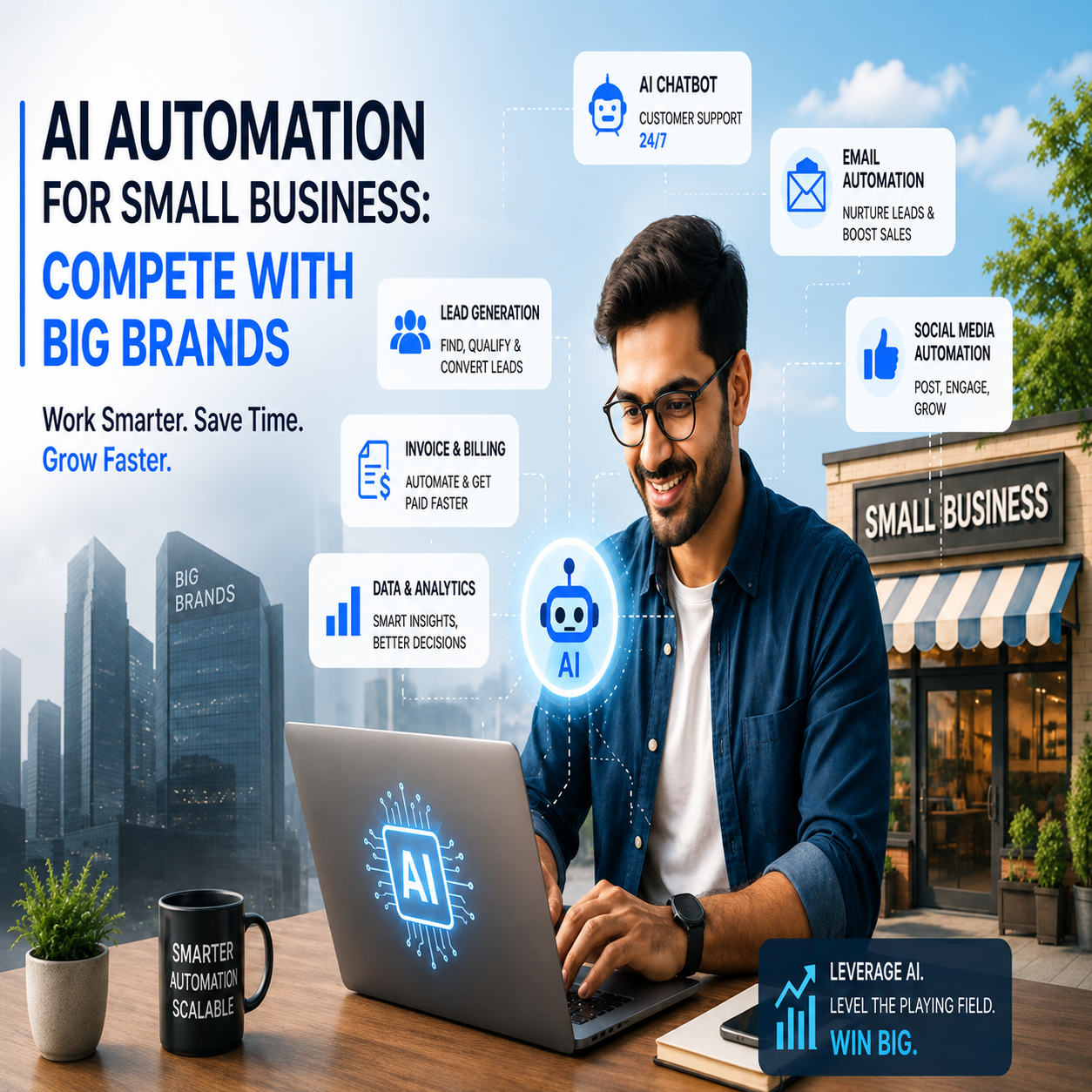
Big brands used to win on budget alone — bigger ad spend, bigger teams, bigger software stacks. That gap is closing fast. AI automation for small business now makes it possible for a two-person shop to respond to leads, run marketing, and support customers with the same speed and consistency as a company 50 times its size. Small firms are adopting AI faster than any technology cycle before it — one 2026 analysis notes that unlike past shifts such as broadband, small businesses are closing the gap with large enterprises in months instead of years, largely because free tools like ChatGPT, Claude, and Gemini removed the cost barrier (AdAI, 2026). This guide shows exactly where to apply AI automation first, what results to expect, and how to avoid the mistakes that keep most small businesses stuck at the "experimenting" stage.
Why AI Automation Is the Great Equalizer for Small Business
Big brands compete on scale — more staff answering calls, more budget for ads, more tools stitched together by IT teams. AI automation removes that advantage because a single owner-operated business can now run the same core functions — lead response, follow-up, content, and reporting — without hiring for them.
The adoption data backs this up: small businesses using generative AI jumped from 23% in 2023 to 58% in 2025, a near-tripling in two years (U.S. Chamber of Commerce, 2025). Growth and AI adoption are also directly linked — growing small businesses are 83% likely to have adopted AI, compared to just 55% of declining businesses, and 78% of growing SMBs plan to keep increasing that investment (AdAI, 2026). Interestingly, it's not the mid-sized firms leading the charge — the very smallest businesses, under five employees, over-index on AI use, treating it as their first "hire" (U.S. Census Bureau / SBA, 2025).
1. Instant Lead Response: Win the Deal Before Big Brands Reply
Big brands are often slower to respond simply because of internal process. Small businesses that automate their first response can beat them to the sale every time — 78% of customers hire whichever company responds first when comparing service providers (DeanTek, 2026).
✅ Where to apply it:
- AI chat widgets that qualify and route leads instantly, 24/7
- Missed-call text-back automation for phone-based businesses
- SMS follow-up sequences — SMS response rates average 45%, versus roughly 6% for email, making it the highest-engagement channel for time-sensitive offers
2. AI-Powered Marketing: Produce Like an Agency, Spend Like a Solo Founder
Content creation is the single largest AI use case for small business, and marketers are all-in on it: 94% of marketers plan to use AI in their content creation process, with content creation, data analysis, and workflow automation as the three leading applications (HubSpot State of Marketing, 2026). Marketing automation also delivers some of the most consistently validated ROI in the category — 77% of marketers report higher conversion rates after adopting it (DeanTek, 2026).
- AI-assisted blog and social content, repurposed across channels from a single brief
- Automated email/SMS nurture sequences replacing manual follow-up
- AI-generated ad variations tested automatically for performance
3. Customer Service Automation: Cover the Hours You Never Staffed
A chatbot or AI voice agent doesn't need to replace a team member — it just needs to cover the after-hours and overflow inquiries no one was answering anyway. That's why AI-powered customer service consistently shows strong returns: businesses report $3.50 in returns for every $1 invested in AI-powered customer service systems (multiple analyst estimates, 2025, via DeanTek). More broadly, 91% of small businesses using AI report measurable revenue increases, and small businesses using AI are 2.3x more likely to report revenue growth than non-users (Salesforce / U.S. Chamber of Commerce, 2025–2026).
4. Back-Office Automation: Reclaim the Hours Big Brands Pay Staff For
Big brands throw headcount at admin work — invoicing, scheduling, reporting, data entry. Small businesses can automate the same tasks directly.
High-impact areas:
- Automated invoicing, reminders, and reconciliation
- AI-assisted scheduling and appointment confirmations
- Auto-generated performance reports and dashboards
Marketing, customer service, and administrative work remain the top three reported AI use cases among small businesses — the common thread being work a small team simply can't keep up with manually (Intuit QuickBooks Small Business Insights, 2025).
Where Small Businesses Are Still Falling Behind
Adoption is high, but strategy is thin. Only 8% of businesses reach advanced AI adoption levels, with most still testing one or two use cases without a broader plan (Salesforce SMB Trends Report, 2024). 77% of small businesses using AI have no formal prompting strategy or system, and only 23% have received any formal training on the tools they use (Aufsite Research / Booth Associates, 2026). This is the gap that separates businesses getting a real competitive edge from businesses that just "tried ChatGPT once."
Traditional Operations vs AI-Automated Small Business
| Traditional Small Business | AI-Automated Small Business |
|---|---|
| Leads answered during business hours only | Leads qualified and routed 24/7 |
| Manual follow-up emails, often delayed | Automated SMS/email sequences within minutes |
| Content created ad hoc, inconsistently | AI-assisted content produced on a repeatable schedule |
| Admin work absorbs owner's time | Invoicing, scheduling & reporting run automatically |
| Growth capped by hours in the day | Growth capped only by strategy and demand |
AI Automation Checklist for Small Businesses
| Business Function | What to Automate First |
|---|---|
| Lead response | Chat widget + missed-call text-back |
| Marketing | AI content drafts + automated email/SMS nurture |
| Customer service | FAQ chatbot for after-hours & repetitive queries |
| Sales follow-up | CRM automation with AI-scored leads |
| Operations | Invoicing, scheduling & reporting automation |
How This Connects to AI Search Visibility (GEO)
Automating your operations is only half the equation — AI models like ChatGPT, Gemini, and Google AI Overviews also need to be able to find and recommend your business in the first place. We cover exactly how to structure your website for that in our companion guide, How to Make Your Website AI Search Friendly, which walks through schema markup, EEAT signals, and AI-readable content structure. Together, automation and AI-search visibility are what let a small business look — and perform — like a big brand.
Ready to Automate Your Small Business Like a Big Brand?
Competing with big brands isn't about matching their budget — it's about matching their speed and consistency using AI automation, high-performance websites, and AI-ready SEO built specifically for how your business operates.
As a web development, SEO, and AI automation expert with 12+ years of experience, Ajay Maanju helps small businesses build automated, AI-visible systems that punch above their size.
Contact Now Visit AjayMaanju.comFrequently Asked Questions
What is AI automation for small business?
It's the use of AI tools — chatbots, automated marketing sequences, CRM scoring, and back-office automation — to handle repetitive tasks so a small team can operate with the speed and consistency of a much larger company.
Can small businesses really compete with big brands using AI?
Yes. Adoption data shows small businesses closing the technology gap with large enterprises in months rather than years, largely due to free and low-cost AI tools removing the traditional cost barrier to automation (AdAI, 2026).
Where should a small business start with AI automation?
Start with lead response and customer service automation — they have the fastest, most measurable ROI, since they cover hours and inquiries the business was never staffed to handle manually.
Does AI automation help with SEO and AI search visibility too?
Yes, indirectly. Consistent, automated content and customer engagement builds the authority and structured data signals that AI search engines look for — see our guide on making your website AI search friendly for the technical steps.