
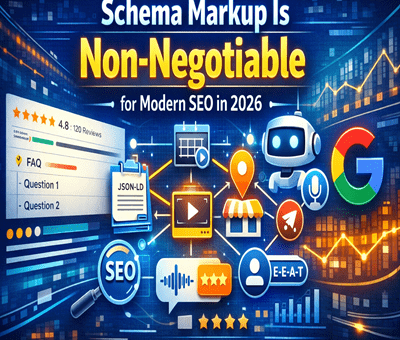
Schema Markup Is Non-Negotiable for Modern SEO in 2026

Schema Markup Is Non-Negotiable for Modern SEO in 2026

SEO, WordPress

SEO in 2026 isn’t just about keywords, back-links, or page speed anymore. If your site doesn’t speak Google’s language, you’re basically whispering in a noisy room. That language is Schema Markup, and at this point, it’s not optional — it’s mandatory.

Let’s break down why schema markup is a must-have for modern SEO and how it directly impacts rankings, visibility, and clicks.


What Is Schema Markup (Quick Recap)

Schema markup is structured data added to your website’s code that helps search engines understand your content contextually, not just textually.

Instead of guessing, Google knows:

  • This is a product

  • That is a review

  • This page answers a question

  • This article is written by an expert

And when Google understands better, it rewards better.


Why Schema Markup Is Non-Negotiable in 2026

1. Search Is Now AI-Driven (Not Keyword-Driven)

Google’s AI models prioritize context, intent, and entities. Schema markup feeds that understanding directly.

No schema = less clarity = weaker visibility.


2. Rich Results = Higher CTR

Schema enables:

  • FAQ dropdowns

  • Star ratings

  • Product prices

  • Event dates

  • How-to steps

These rich results steal attention on the SERP and massively improve click-through rates — even without ranking 1.


3. Voice Search & AI Overviews Depend on Schema

Voice assistants and AI-generated search summaries pull data from structured sources.

If your content isn’t structured, it won’t be selected.

Schema markup increases your chances of:

  • Being cited in AI answers

  • Appearing in voice search responses

  • Showing up in Google AI Overviews


4. E-E-A-T Signals Are Stronger With Schema

Experience, Expertise, Authority, Trust — Google cares deeply.

Schema helps validate:

  • Author credentials

  • Business legitimacy

  • Reviews & ratings

  • Organization details

Basically, schema helps you prove you’re legit, not just claim it.


5. Zero-Click Searches Are Rising

More users get answers directly on Google.

Schema ensures:

  • Your brand still appears

  • Your site gets attribution

  • You stay visible even without a click

If clicks go down, branding and presence matter more than ever.


Must-Have Schema Types in 2026

If you’re serious about SEO, these are table stakes:

  • Organization Schema

  • Website Schema

  • Article / Blog Posting Schema

  • FAQ Schema

  • Breadcrumb Schema

  • Product Schema (for eCommerce)

  • Review & Rating Schema

  • Local Business Schema

Bonus: How To and Video schema if relevant.


Common Schema Mistakes to Avoid

  • Adding schema but not matching page content

  • Using outdated or invalid schema types

  • Forgetting to test with Google’s Rich Results Test

  • Auto-generated spam schema

Bad schema is worse than no schema. Accuracy matters.


Final Thoughts

In 2026, SEO without schema markup is like building a website without SSL — outdated and risky.

Schema markup:

  • Improves visibility

  • Increases CTR

  • Powers AI search

  • Strengthens trust

  • Future-proofs your SEO

If you want Google to understand, trust, and promote your content — schema markup isn’t a “nice to have”. It’s non-negotiable.


SEO VS AEO VS GEO

Shopify Quietly Killed the App Gold Rush in 2026.

Shopify Quietly Killed the App Gold Rush in 2026.

Shopify

Shopify Quietly Killed the App Gold Rush in 2026.

And somehow… made everyone richer.

If you were deep in the Shopify ecosystem before 2026, you remember the app gold rush era.
Build a half-decent app, slap on a $9.99/month price, throw money at ads, and pray merchants stick around longer than one billing cycle.

It worked.
Until it didn’t.

In 2026, Shopify didn’t announce some dramatic reset. No big keynote. No viral blog post.
They just changed the rules quietly.

And the chaos stopped.


The App Gold Rush Was Low-Key Broken

Before 2026, the Shopify App Store had three major problems:

  • Too many apps doing the same thing
    20 apps for popups. 15 for subscriptions. 10 for reviews. Merchants were overwhelmed.

  • Short-term thinking
    Many apps were built to monetize fast, not to last.

  • Merchant burnout
    $5 here, $15 there, suddenly a store owner was paying ₹20k/month just to keep their stack alive.

More apps ≠ more value.
It was noise.


What Shopify Changed (Without Making Noise)

Shopify didn’t ban apps.
They raised the floor.

1. Native Features Ate Weak Apps Alive

Shopify rolled core features directly into the platform:

  • Better analytics

  • Stronger checkout customization

  • Built-in automation

  • Smarter email + customer flows

If your app was just a “nice-to-have” it was over.

2. App Store Quality Became Non-Negotiable

Approval got stricter.
Performance mattered.
UX mattered.
Long-term value mattered.

Spammy, bloated, or redundant apps slowly disappeared.

3. Revenue Models Got Smarter

Developers shifted from:

“$9/month for everyone”
to
“Charge based on value delivered”

Usage-based pricing.
Revenue share alignment.
Fewer installs, higher ARPU.


Why Merchants Won

Merchants didn’t need 12 apps anymore.

They got:

  • Faster stores

  • Fewer subscriptions

  • Cleaner dashboards

  • Tools that actually worked together

Instead of managing tech, they focused on selling.

Less chaos = more profit.


Why Developers Won (Yes, Really)

At first, it hurt.
Installs dropped.
Easy money dried up.

But serious developers stayed—and leveled up.

Now:

  • Fewer competitors

  • Higher-quality customers

  • Longer retention

  • Real businesses, not side hustles

One great app > ten mediocre ones.

Developers stopped chasing virality and started building infrastructure.


Why Shopify Won the Biggest

This move did three things for Shopify:

  1. Reduced platform bloat

  2. Increased merchant trust

  3. Strengthened ecosystem defensibility

Shopify isn’t just a tool anymore.
It’s an operating system for commerce.

And operating systems don’t need a million plugins—
they need the right ones.


The Real Takeaway

The app gold rush didn’t end because apps failed.
It ended because the platform matured.

2026 wasn’t about killing opportunity.
It was about killing shortcuts.

And in the long run:

  • Merchants made more

  • Developers earned better

  • Shopify became stronger

Quiet changes.
Massive impact.

Sometimes the best revolutions don’t trend on X.
They just work.

Hire Shopify Developer India