SEO vs AEO vs GEO: Which One Will Actually Grow Your Business in 2026?

SEO vs AEO vs GEO: Which One Will Actually Grow Your Business in 2026?

SEO, WordPress

If your website traffic is stuck, leads are low, or AI tools never mention your brand — you’re not alone.

Search has evolved.
And businesses still using only traditional SEO are already falling behind.

Today, real growth comes from understanding SEO, AEO, and GEO — and using them together strategically.

Let’s break it down in a business-first way


What Is SEO (Search Engine Optimization)?

SEO helps your website rank higher on Google when people search for services, solutions, or products.

How SEO Drives Sales

SEO works by:

  • Targeting high-intent keywords

  • Optimizing website structure & content

  • Building trust through backlinks & authority

  • Improving user experience & page speed

 Result: More organic traffic + qualified leads

Best Business Use Cases

  • Local service businesses

  • IT & digital agencies

  • E-commerce websites

  • Bloggers & content creators

  • Long-term lead generation

SEO Pros

  • Sustainable traffic growth

  • High ROI over time

  • Builds brand credibility

  • Works across all industries

SEO Cons

  • Slow initial results

  • Competitive keywords need patience

  • Requires consistent optimization


What Is AEO (Answer Engine Optimization)?

AEO focuses on ranking your content as direct answers in Google, voice search, and smart assistants.

Think featured snippets, FAQs, and voice results.

How AEO Boosts Conversions

AEO optimizes content for:

  • “People Also Ask” results

  • Google featured snippets

  • Voice assistants (Alexa, Siri, Google Assistant)

  • Zero-click searches

Result: Instant trust + higher brand authority

Best Business Use Cases

  • Service-based websites

  • FAQ-heavy industries

  • Local businesses

  • Customer support & help pages

AEO Pros

  • Position zero visibility

  • Perfect for voice search

  • Builds instant credibility

  • Improves UX

AEO Cons

  • Fewer clicks in some cases

  • Needs precise content formatting

  • Limited space for branding


What Is GEO (Generative Engine Optimization)?

GEO is about optimizing your content so AI tools like ChatGPT, Gemini, Perplexity, and other generative engines recommend or reference your brand.

This is the future of search.

How GEO Works for Business Growth

GEO focuses on:

  • In-depth, authoritative content

  • Natural language & context

  • Brand mentions & topical authority

  • Original insights (not generic blogs)

Result: Brand visibility inside AI-generated answers

Best Business Use Cases

  • IT companies & SaaS brands

  • Digital agencies & consultants

  • Thought leaders

  • Knowledge-driven businesses

GEO Pros

  • Early-mover advantage

  • Strong brand positioning

  • AI-first visibility

  • Complements SEO & AEO

GEO Cons

  • Still evolving

  • Harder to track metrics

  • No fixed ranking system yet


SEO vs AEO vs GEO: Business Comparison

Factor SEO AEO GEO
Goal Traffic & leads Instant answers AI recommendations
Platform Google & Bing Voice & answer engines AI tools
Best For Long-term growth Trust & visibility Future-proof branding
ROI High (long-term) Medium–High Very high (early stage)

The Smart Strategy: Combine All Three

Businesses that win in 2026 don’t choose one — they combine SEO + AEO + GEO.

  • SEO brings traffic

  • AEO converts attention into trust

  • GEO positions your brand where AI looks for answers

If your competitors are still stuck on keywords only — this is your edge.


 Want This Strategy Implemented for Your Business?

If you want:

  • Higher Google rankings

  • More qualified leads

  • Visibility in AI search tools

  • A future-proof digital presence

Now is the time to upgrade your search strategy.

SEO alone is no longer enough.

SEO Trends 2026

How to Implement Schema Markup for Higher SEO Performance

How to Implement Schema Markup for Higher SEO Performance

WordPress

In the era of digital technologies, it is no longer about great content and high-quality back-links that get to the top of Google. Search engines are currently looking for structured, organized and machine-readable data. Schema Markup is where the picture comes in. Schema is possibly one of the most effective tools for ensuring your website is included in rich results, dominating the SERPs, and receiving more organic clicks.

This blog will explain what schema markup is, why it is important, and how you can add schema markup step-by-step to increase your search presence.

What Is Schema Markup?

Schema markup is essentially a structured data inserted into the code of your website that assists the search engines in knowing what your content entails, rather than what it reflects.

Major search engines such as Google, Bing, Yahoo, and Yandex introduced it as a common vocabulary under Schema.org.

Adding schema provides search engines with additional context of your content, e.g.:

  • Is the page an article?
  • Is it a recipe?
  • Is it a priced and reviewed product?
  • Is it an FAQ page?

This supplementary data will assist Google in showing rich snippets, knowledge panels, and augmented search results, all of which enhance appearance.

Why Is Schema Markup Important for SEO?

Schema markup does not boost rankings directly, but it will radically improve the appearance of your pages on Google. This results in increased click-through, more impressions and increased visibility.

  1. Helps Search Engines Learn Your material

A schema makes what you have read machine-readable. This transparency is such that search engines index your site better.

  1. Improves Search Results with Rich Results

Using schema, your entries may look like:

  • Star ratings
  • FAQs
  • Images
  • Price and availability
  • Event dates
  • Breadcrumbs

Such pictures have more clicks than simple text descriptions.

  1. Improves Organic CTR

Rich snippets attract the user’s attention. Although you might remain in the same rank, you have more chances of being clicked because your result appears better.

  1. Develops Trust and Credibility

The more your pages display systematized, tested information such as reviews or product descriptions, the more users are likely to trust your brand.

  1. Voice Search Optimization

Schema is designed to make voice assistants, such as Google Assistant or Siri, comprehend your information in order to have a better shot at appearing in voice search results.

How Schema Markup Works

Schema markup is typically written in one of the following forms:

  • JSON-LD (recommended by Google)
  • Microdata
  • RDFa

Of these, JSON-LD is the simplest and the least messy format since it does not interfere with your existing HTML as it is placed within the <script> tag.

Example of a simple Article schema in JSON-LD:

<script type=”application/ld+json”>

{

“@context”: “https://schema.org”,

“@type”: “Article”,

“headline”: “How to Use Schema Markup to Improve Search Visibility”,

“author”: “Priyanka Mondal”,

“datePublished”: “2025-12-03”

}

</script>

Types of Schema Markup You Can Use

The number of schemas on schema.org is greater than 800. However, all you have to do is think about the ones that are pertinent to your content.

  1. Article Schema

Good in blogs, news and editorial articles.

  1. FAQ Schema

Displays the frequently asked questions on the Google result page.

  1. Breadcrumb Schema

Enhances navigation and URL format representation.

  1. Product Schema

Displays product specifications such as price, reviews and availability- ideal in eCommerce.

  1. Review Schema

SERPs with star ratings.

  1. How-To Schema

It can be helpful in step-by-step instructions.

  1. Local Business Schema

Increases the visibility of local service providers.

  1. Event Schema

Advertises webinars, workshops, or face-to-face.

  1. Recipe Schema

The one with cooking blogs has pictures, calories, and ingredients.

  1. Organization Schema

Knowledge panels are optimized using your brand.

Step-by-Step Guide: How to Use Schema Markup to Improve Search Visibility

Schema markup might not appear very user-friendly; however, once you have the process, it will become an easy and effective method of SEO. This is the step-by-step guide to assist you in implementing it and enhancing the way your site will be shown in search results.


Step 1: Find the appropriate pages

The first step is to choose which pages will be most useful with structured data, e.g. blog posts, product pages, frequently asked questions, service pages, or event listings. Commonly, these pages can be improved with a better search facility.

Step 2: Select the right type of schema

According to the content of the page, select an appropriate schema in Schema.org. An example is the use of Article schema with blogs, Product schema with eCommerce pages and FAQ schema with question-based content.

Step 3: Code your schema markup

Easily made in tools such as Google Structured Data Markup Helper, Merkeles Schema Generator, or WordPress plugins such as Rank Math and Schema Pro, the JSON-LD code can be generated.

Step 4: Add the schema to your site

Sometimes you can add the JSON-LD script directly into the head part of your webpage to make it work, or add it with a plugin to make it work without writing code.

Step 5: Test and validate

Lastly, test your structured data by the Rich Results Test or the Schema Validator of Google or, better, both of these tools to confirm that everything is in order and ready to be displayed as a rich result.


Best Practices for Using Schema Markup

Following schema markup best practices ensures accuracy, prevents errors, and maximizes your chances of earning rich results and stronger search visibility.

  1. Always Use JSON-LD Google-Preferred

It is not mixed with HTML and is less difficult to maintain

  1. Not to Stuff With the Irrelevant Information Schema

Add the schema only then, which actually reflects the content

  1. Use Accurate, Up-to-Date Data

Google punishes incorrectly structured data.

  1. Avoid Duplicate Schema

When your schema is already added by your plugin or theme, then you should turn off duplicates, which will result in errors.

  1. Keep Schema Updated

Should any prices, dates or reviews be modified, rewrite your schema as well.

  1. Uphold Clean Coding

Ensure code quality so your structured data aligns with schema.org standards

Examples of Schema That Boost Visibility

1. FAQ Schema Example

<script type=”application/ld+json”>

{

“@context”: “https://schema.org”,

“@type”: “FAQPage”,

“mainEntity”: [{

“@type”: “Question”,

“name”: “What is schema markup?”,

“acceptedAnswer”: {

“@type”: “Answer”,

“text”: “Schema markup is structured data used by search engines to understand your content better.”

}

}]

}

</script>

2. Product Schema Example

{

“@context”: “https://schema.org”,

“@type”: “Product”,

“name”: “Wireless Earbuds”,

“description”: “High-quality Bluetooth earbuds with noise cancellation.”,

“offers”: {

“@type”: “Offer”,

“price”: “1999”,

“priceCurrency”: “INR”,

“availability”: “https://schema.org/InStock”

}

}

Benefits You Can Expect After Implementing Schema

Implementing schema markup can significantly enhance how search engines read and display your content. It improves visibility, boosts click-through rates, and makes your pages more appealing with rich, informative search results.

  • Higher organic visibility
  • Higher click-through rate
  • More qualified traffic
  • Rich snippets for your pages
  • Improved user engagement
  • Better brand credibility
  • Improved conversion rates

The schema markup does not promise any ranking improvement, but it greatly enhances the presentation of your content, which, of course, benefits the overall SEO.

Conclusion

Schema markup is among the least appreciated SEO techniques, but it will change the way your site looks in Google. Regardless of the type of blog, service web or eCommerce store, structured data allows search engines to know more about your content and display it in a more appealing manner.

With the proper schema type, use of JSON-LD, testing your markup, and the monitoring of performance, you can increase your search visibility and organic traffic by a significant margin.

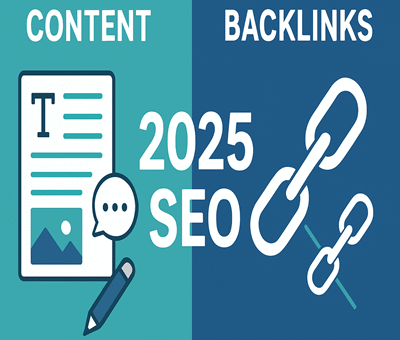
Content vs Backlinks: What Really Matters in 2025 SEO

Content vs Backlinks: What Really Matters in 2025 SEO

SEO

The debate around content vs backlinks has been going on for years in the SEO world. As we step into 2025, the rules of Google ranking continue to evolve, but one question remains: what really matters more — content or backlinks? Let’s break it down.


The Role of Content in 2025

Content has always been the backbone of SEO. In 2025, Google’s algorithms have become smarter than ever, focusing heavily on:

  • Relevance & Depth: Shallow content is quickly ignored. In-depth, niche-specific content ranks higher.

  • User Experience: Content that satisfies intent — whether informational, transactional, or navigational — performs better.

  • E-E-A-T Factors: Experience, Expertise, Authoritativeness, and Trustworthiness are now non-negotiable.

High-quality content also naturally attracts backlinks, making it a double win.


The Power of Backlinks in 2025

Backlinks are still a major ranking factor, but their quality outweighs quantity more than ever before. Google now focuses on:

  • Relevance of Links – Links from niche-related sites have more impact.

  • Authority of Domains – Backlinks from trusted, established websites remain powerful.

  • Natural Link Building – Paid or manipulative link schemes are riskier than ever.

Backlinks act as endorsements, proving your site deserves attention.


Content vs Backlinks: The Real Answer

The truth is — you can’t ignore either. In 2025, SEO success comes from balancing both:

  • Without great content, backlinks won’t stick.

  • Without quality backlinks, even the best content may struggle to rank.

Think of content as the foundation and backlinks as the fuel. Together, they drive visibility and authority.


Final Thoughts

In 2025, the SEO game isn’t about choosing between content vs backlinks — it’s about leveraging both strategically. Create valuable, audience-focused content and amplify it through authentic backlink building. That’s the formula for long-term rankings and online growth.

Affordable SEO India

How to Rank a New Website on Google in Just 90 Days

How to Rank a New Website on Google in Just 90 Days

SEO

Launching a new website is exciting, but the real challenge begins when you want it to rank on Google. The truth is, search engine optimization (SEO) is a marathon, not a sprint. However, with the right strategy and consistent efforts, you can start seeing significant results in as little as 90 days.

Here’s a step-by-step guide to help your new website climb Google’s search rankings:


1. Build a Strong Foundation (Week 1–2)

  • Keyword Research: Use tools like Google Keyword Planner, Ahrefs, or SEMrush to find low-competition, high-intent keywords.

  • On-Page SEO: Optimize titles, meta descriptions, headers, and URLs.

  • Mobile-Friendly & Fast Loading: Google prioritizes websites with good user experience, so make sure your site is responsive and optimized for speed.


2. Publish High-Quality Content (Week 2–6)

  • Create pillar content around your main topics and support them with blog posts.

  • Focus on user intent—write content that solves real problems for your target audience.

  • Publish consistently—Google loves fresh content.


3. Build Authority with Backlinks (Week 4–10)

  • Guest post on relevant blogs in your niche.

  • Submit your website to directories and forums.

  • Collaborate with influencers or industry experts for mentions and backlinks.

  • Use social sharing platforms like LinkedIn, Reddit, and Quora to promote your content organically.


4. Optimize for Technical SEO (Ongoing)

  • Submit your sitemap to Google Search Console.

  • Fix broken links, improve internal linking, and set up proper redirects.

  • Optimize images with alt tags and compression.

  • Ensure HTTPS security for trustworthiness.


5. Track, Analyze & Adjust (Week 8–12)

  • Use Google Analytics and Search Console to track keyword rankings, impressions, and clicks.

  • Double down on content that performs well.

  • Update and repurpose old blogs to keep them relevant.


6. Leverage Local SEO (If Applicable)

  • Register your business on Google Business Profile.

  • Collect reviews from happy customers.

  • Target location-based keywords.


Final Thoughts

Ranking a new website on Google in just 90 days requires focus, effort, and patience. By combining quality content, backlinks, technical optimization, and consistent analysis, you can dramatically improve your visibility in search results.

Remember—SEO is an ongoing process. The key is consistency and adaptability.

Affordable SEO India