
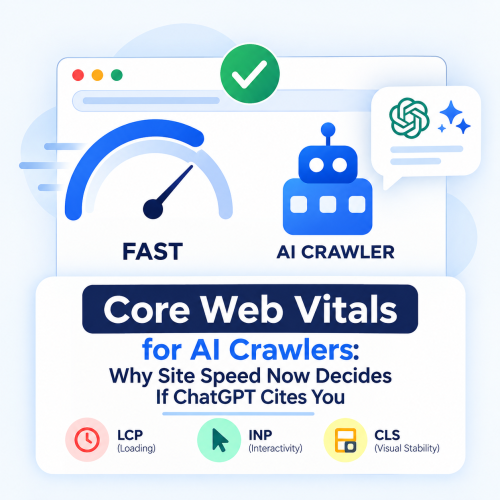
Core Web Vitals for AI Crawlers: Why Site Speed Now Decides If ChatGPT Cites You
Here's a claim you'll see a lot right now: "improve your Core Web Vitals and ChatGPT will start citing you." It sounds logical. It's also only half true, and the half that's missing is the part that actually matters for your traffic.
Core Web Vitals for AI crawlers work differently than they do for Google. Googlebot is patient — it renders your JavaScript, waits for slow scripts, and measures how a real visitor experiences your page over time. GPTBot, PerplexityBot, and Claude's crawler are not patient at all. Most give up on a page in one to five seconds, and most never execute your JavaScript in the first place (tryanalyze.ai, 2026). That distinction changes everything about what you should actually fix first.
What Are Core Web Vitals, Quick Refresher
Core Web Vitals are Google's three field metrics for real-world page experience:
- LCP (Largest Contentful Paint) — how long the biggest visible element takes to load
- INP (Interaction to Next Paint) — how quickly the page responds when someone clicks or taps, which formally replaced FID as a ranking signal in the March 2026 core update (Dotcom-Monitor, 2026)
- CLS (Cumulative Layout Shift) — how much the page visually jumps around while loading
Right now, only about 42% of mobile sites pass all three thresholds (Digital Applied, 2026). If you're in the 58% that don't, you're not alone — but you are leaving both rankings and AI visibility on the table.
Do Core Web Vitals Actually Affect Whether ChatGPT Cites You?
Directly? Not really. Indirectly? Absolutely — and this distinction is the whole point of this article.
One detailed technical breakdown puts it bluntly: Core Web Vitals correlate with organic ranking, but they don't correlate with AI citation, because answer engines fetch pages using an entirely different mechanism than Google's main crawler (Citevera, 2026). AI crawlers aren't scoring your LCP or your CLS at all. What they're actually checking is much more basic: can I get your raw HTML back fast enough to read it?
That's where speed still decides your fate — just not through the metric most people are chasing.
Why AI Crawlers Behave Completely Differently Than Googlebot
| Behavior | Googlebot | AI Crawlers (GPTBot, PerplexityBot, ClaudeBot) |
|---|---|---|
| Patience for slow pages | High — will wait and retry | Low — typically gives up in 1–5 seconds |
| Executes JavaScript | Yes | Mostly no — reads raw HTML only |
| Measures visual layout shifts | Yes (CLS) | No |
| Cares about Interaction to Next Paint | Yes | No — it never "interacts" with the page |
| What actually gates it | Full Core Web Vitals | TTFB (Time to First Byte) and clean, pre-rendered HTML |
This is the detail most SEO advice glosses over: a page can pass Core Web Vitals perfectly in the field — because real Chrome users render its JavaScript — and still be invisible to AI systems, because the crawler itself never waits around for that JavaScript to finish (tryanalyze.ai, 2026).
The Data: Speed, TTFB, and Citation Rates in 2026
| Metric | Finding | Source |
|---|---|---|
| AI crawler timeout window | 1–5 seconds before giving up | tryanalyze.ai, 2026 |
| TTFB threshold most AI crawlers tolerate | Under 600ms recommended | Inspirable, 2026 |
| Common cause of missed AI crawls | TTFB above 1–2 seconds (cold serverless functions, no CDN) | Menra, 2026 |
| Brand mention correlation with AI Overview visibility | 0.67 — roughly 3x stronger than backlinks | Ahrefs / andlisten.com, 2026 |
| AI visibility boost from adding statistics to content | +22% to 41% | Princeton/Georgia Tech GEO study, 2026 |
| AI visibility boost from citing credible sources | +28% to 37% | Princeton/Georgia Tech GEO study, 2026 |
| Share of AI Overview citations from top 30% of a page | 55% | CXL research, 2026 |
| AI-cited content freshness vs typical search results | 25.7% fresher | Ahrefs, 2026 |
| AI-referred traffic conversion rate vs traditional search | 14.2% vs 2.8% | Discovered Labs, 2026 |
That last stat is worth sitting with. Even though AI referral traffic volume is still smaller than organic search, it converts roughly five times better — which makes fixing crawlability a genuinely high-ROI fix, not a vanity metric.
7 Things That Actually Matter for AI Crawlability (In Priority Order)
1. Fix your TTFB first.
If your server takes more than a second to respond, an AI crawler may abandon the request before it ever sees your content. This is the single most common reason great content never enters the AI citation pool (Menra, 2026).
2. Serve complete HTML without relying on JavaScript to render the content.
GPTBot, PerplexityBot, and Claude's crawler read raw HTML and mostly skip client-side rendering. If your key content only appears after JavaScript runs, server-side render it or pre-render a static version.
3. Add FAQ, Article, and LocalBusiness schema.
Between chasing 400ms off your LCP and adding FAQPage schema, the schema is the one that actually moves AI citation — not the speed shave (Citevera, 2026).
4. Put your best content in the top 30% of the page.
Since over half of AI Overview citations pull from the top third of a page's content, don't bury your strongest paragraph under three paragraphs of throat-clearing.
5. Back up claims with real statistics and credible citations.
Content with concrete numbers and named, credible sources sees a measurable jump in AI visibility — this isn't stylistic advice, it's a documented ranking factor for generative engines.
6. Keep content genuinely fresh.
AI-cited pages are noticeably fresher than the average search result. A "last updated" pass every few months isn't busywork — it's a visibility lever.
7. Allow verified AI crawlers through your bot management.
Some security or CDN configurations block bots indiscriminately, including legitimate AI crawlers. Check your robots.txt and firewall rules aren't accidentally locking ChatGPT and Perplexity out entirely.
Traditional CWV Optimization vs LLM-Crawlability Optimization
| Traditional SEO Focus | AI-Crawlability Focus |
|---|---|
| Optimize LCP, INP, CLS for human visitors | Optimize TTFB and raw HTML delivery for bots |
| Lazy-load images and defer JavaScript | Ensure critical content exists without JS execution |
| Improve Lighthouse score | Ensure crawler doesn't time out before reading the page |
| Ranking is a slow-moving, tie-breaker signal | Citation is a binary gate — you're either fetched or you're not |
Site Speed & AI-Crawlability Checklist
| Item | Why It Matters |
|---|---|
| TTFB under 600ms | Keeps you inside every major AI crawler's timeout window |
| Server-side rendered or pre-rendered HTML | Ensures content is visible without JS execution |
| CDN in front of your origin server | Removes the single biggest cause of slow, inconsistent TTFB |
| FAQ / Article / LocalBusiness schema | Directly increases AI citation eligibility |
| Key answer within the first third of the page | Matches where 55% of AI citations are pulled from |
| Statistics and named sources in your content | Documented to boost AI visibility 22–41% |
| Robots.txt allows GPTBot, PerplexityBot, ClaudeBot | Prevents accidentally blocking legitimate AI crawlers |
How This Connects to Zero-Click Search and AI Search Visibility
This post sits right alongside two things we've already covered. If you haven't read Zero-Click Search Is Here: How to Get Traffic When 58% of Searches Never Get a Click, the short version is that visibility inside AI answers is replacing clicks as the metric that matters — and crawlability is the first gate you have to clear to be visible at all. We also cover the broader technical setup in How to Make Your Website AI Search Friendly, which pairs well with the speed fixes here. Speed gets you through the door; structure and authority are what get you cited once you're inside.
Want Your Site Fast Enough for AI Crawlers to Actually Read It?
A slow origin server or a JavaScript-only render can quietly keep your best content out of ChatGPT, Perplexity, and Google AI Overviews — no matter how good the writing is.
As a web development and SEO expert with 12+ years of experience, Ajay Maanju builds high-performance, server-rendered WordPress sites engineered for fast TTFB, clean HTML delivery, and AI-crawler accessibility.
Contact Now Visit AjayMaanju.comFrequently Asked Questions
Do Core Web Vitals directly affect ChatGPT citations?
Not directly. Core Web Vitals measure real-user experience through JavaScript rendering, which most AI crawlers never execute. What actually gates AI citation is TTFB and whether your raw HTML loads fast enough before the crawler's timeout.
How fast does my TTFB need to be for AI crawlers?
Under 600 milliseconds is the commonly recommended target. Most AI crawlers give up within 1 to 5 seconds if a page hasn't returned usable content by then.
Does JavaScript hurt my chances of being cited by AI?
It can. GPTBot, PerplexityBot, and Claude's crawler mostly read raw HTML and skip client-side rendering. If your core content only appears after JavaScript runs, server-side rendering or static pre-rendering is essential.
Is it better to focus on Core Web Vitals or schema markup for AI visibility?
If you have limited engineering time, prioritize schema (FAQ, Article, LocalBusiness) — it has a more direct, measurable effect on AI citation than shaving milliseconds off LCP.
Does AI-referred traffic actually convert better than regular search traffic?
Early data suggests yes — one analysis found AI-referred visitors converting at roughly 14.2% compared to 2.8% for traditional organic search traffic, though this varies by industry and should be verified against your own analytics.