
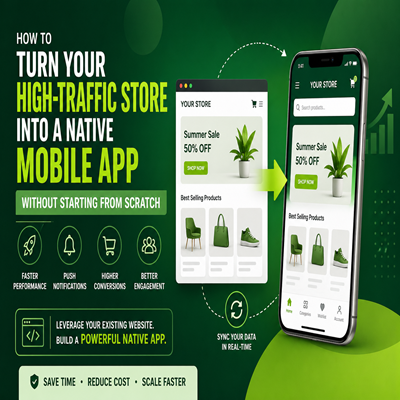
Your high-traffic store is already winning on the web — so the next logical question is whether you should be investing in mobile application services to take that audience native. The good news: you don’t need to throw away your existing store, your CMS, or your product catalog to launch a mobile app. With the right approach, you can turn your existing store into a fast, polished native experience for iOS and Android in weeks instead of months.
In this guide, we’ll walk through the practical, modern path to converting an existing high-traffic store into a native mobile app — what to reuse, what to rebuild, what to avoid, and how to choose the right partner for mobile application services. If you also want a free, expert review of your current store before you commit, grab our free website audit.
A native app isn’t a vanity project — for a busy store, it’s a revenue lever. Mobile commerce now drives the majority of online retail interactions. According to Statistic, mobile devices accounted for roughly over 60% of global website traffic, and shoppers spend significantly more time inside native apps than on mobile web. That gap is exactly why merchants invest in mobile application services: native apps offer push notifications, faster checkout, offline browsing, bio-metric login, and a home-screen icon that brings customers back without paying for re-acquisition.
If your store is already getting consistent traffic, you have something most app builders don’t: proof of demand. You don’t need to guess what users want — you have data, best-sellers, and a working brand. That’s the perfect launch pad for a native app.
- Your mobile traffic share is consistently above 50%.
- You have a base of repeat customers who buy more than twice a year.
- You spend heavily on re-targeting ads to bring shoppers back.
- Your competitors already have an app (or are about to launch one).
- Cart abandonment is highest on mobile browsers — push notifications can rescue most of it.
The biggest myth about mobile application services is that going native means rebuilding your entire back-end, redesigning your catalog, and re-syncing inventory from zero. That’s outdated thinking. Modern app development reuses everything you already own — your CMS, your payment gateway, your product database, your shipping logic, and your design system — and wraps a native experience around them.
If you already have a polished store (especially on WordPress, Woo-commerce, Shopify, or Magneto), the heavy lifting is done. Our mobile app development service is built specifically for this scenario: keep your store, add a native layer, ship to the App Store and Play Store.
There isn’t one “right” way to convert a store. Choose the path that matches your traffic volume, budget, and growth goals.
Use your existing store as a headless back-end — the storefront API serves products, cart, and checkout — while a native iOS and Android app handles the UI. This is the gold standard for high-traffic stores because it gives you the speed and feel of a true native app without rebuilding business logic. It’s what most enterprise mobile application services recommend in 2026.
One codebase deploys to both iOS and Android. You reuse your store’s APIs, your branding, and your checkout flow, and you ship two apps from one team. For mid-sized stores doing under $5M/year, this is usually the most cost-effective option.
If you’re not ready to commit to native yet, a PWA gives you most of the benefits — installable icon, offline mode, push notifications on Android — at a fraction of the cost. We’ve covered this in detail in our guide to PWA vs Native apps for WordPress websites. Many high-traffic stores launch a PWA first, then graduate to native once mobile revenue justifies it.
If you’re on Woo-commerce, plugins and SDKs can convert your store into a native app shell with deep API integration. We pair this with our shopping cart design and WordPress customization services to ensure performance, conversion, and mobile UX are optimized before the app ever launches.
Not every agency offers the full stack. When you’re evaluating mobile application services, make sure the scope covers the entire lifecycle — not just the “build” phase. A proper engagement should include:
- Discovery & UX audit — mapping your current store flows to native screens.
- API integration — connecting to your existing CMS, cart, and payment gateway.
- Native UI design — iOS Human Interface Guidelines and Material 3 compliant.
- Push notification engine — for cart recovery, restocks, and promotions.
- Analytics & crash reporting — Firebase, Mix-panel, or your existing stack.
- App Store and Play Store submission — including review prep and rejection handling.
- Post-launch support — OS updates, security patches, and iteration.
You can see the full menu of what we deliver under our services — from strategy to launch to long-term maintenance.
Realistic timelines, assuming you already have a live store with stable APIs:
- PWA conversion — 2 to 4 weeks.
- Hybrid app (React Native / Flutter) — 6 to 10 weeks.
- Fully native iOS + Android with custom features — 10 to 16 weeks.
- Headless commerce overhaul + native app — 12 to 20 weeks.
Anyone promising a “native app in 5 days” is selling you a wrapper around your mobile website — that’s not a real app, and the App Store will often reject it.
- Copy-pasting the desktop UX. Mobile users tap, swipe, and scroll — they don’t hover or right-click. The IA has to be redesigned around thumbs.
- Skipping push notification strategy. Push is the #1 reason native outperforms web. Plan it before you build.
- Ignoring app store SEO (ASO). Your app needs keywords, screenshots, and reviews — not just code.
- Forgetting analytics. Without funnel tracking inside the app, you’ll never know why mobile conversions changed.
- Choosing the cheapest vendor. Cheap mobile application services usually mean Web-view wrappers, no native polish, and rejected store submissions.
Use this short checklist before you sign any contract:
- Do they have published apps live on both Apple App Store and Google Play?
- Can they show conversion lift data from previous store-to-app projects?
- Do they own the entire stack — design, native code, back-end integration, and ASO?
- Do they offer post-launch maintenance, or do they disappear after delivery?
- Are their mobile application services transparent on cost, timeline, and code ownership?
If you want a partner who actually checks every one of those boxes, request a free consultation and we’ll walk you through your store, your data, and your fastest path to a native app.
1. Do I need to rebuild my online store to launch a mobile app?
No. Modern mobile application services reuse your existing CMS, product database, and payment gateway through APIs. You keep the store you already own and add a native layer on top.
2. What is the average cost of converting a high-traffic store into a mobile app?
For a mid-sized store, hybrid React Native or Flutter apps typically range from $8,000 to $35,000. Fully native iOS + Android builds with advanced features usually start around $25,000 and scale up with complexity.
3. Will a native app actually increase my revenue?
For stores with repeat-buyer behavior, yes. Native apps consistently produce higher session times, higher AOV, and 2x to 4x repeat purchase rates compared to mobile web — primarily because of push notifications and one-tap checkout.
4. iOS, Android, or both — which one should I launch first?
Launch both. Cross-platform frameworks like React Native and Flutter make it inexpensive to do so, and your customer base is almost certainly split between the two ecosystems.
5. Can a mobile app be developed without coding from scratch?
Yes — through hybrid frameworks, headless commerce APIs, and reusable design systems, professional mobile application services can launch a native-quality app while reusing 60–80% of your existing store’s logic and content.
6. How do you handle App Store and Play Store approvals?
A reliable partner takes care of submission, store listings, screenshots, privacy policy, in-app purchase compliance, and rejection appeals — all part of a complete mobile application services engagement.
You spent years building traffic, trust, and inventory in your store. Don’t throw any of that away to chase a native app — extend it instead. With the right mobile application services partner, your existing store becomes the engine and your native app becomes a high-conversion, high-retention storefront in your customer’s pocket.
If you’d like a tailored roadmap for your store, start with a quick free website audit, browse more articles on the blog, or reach out directly to discuss your mobile app development project. The fastest path to a great app starts with the store you already have.